
Damaged or missing teeth can affect your ability to chew, speak, and smile comfortably. Fortunately, modern restorative dentistry offers several ways to rebuild damaged teeth and replace missing ones. Two common options are dental crowns and bridges.
Although both can restore the appearance and function of your smile, they serve different purposes. Understanding how crowns and bridges work can help you have a more informed conversation with your dentist.
At Sapphire Family Dentistry in Katy, TX, restorative treatments are tailored to each patient’s dental needs, existing tooth structure, and long-term oral health goals.
What Is a Dental Crown?
A dental crown is a custom-made restoration that covers a damaged or weakened tooth. It can restore the tooth’s shape, strength, appearance, and function.
Crowns may be recommended when a tooth has:
- Extensive decay
- A large filling
- Significant cracks or damage
- Been weakened after root canal treatment
- Severe wear
- Cosmetic concerns that cannot be addressed with simpler treatments
A crown essentially acts as a protective covering over the remaining tooth structure.
You can learn more about dental crowns and bridges and the restorative options available at Sapphire Family Dentistry.
What Is a Dental Bridge?
A dental bridge is designed to replace one or more missing teeth. It typically consists of an artificial tooth, called a pontic, supported by crowns attached to neighboring teeth.
A bridge fills the space created by tooth loss and can help restore chewing function and the appearance of your smile.
Replacing a missing tooth can also help prevent neighboring teeth from shifting into the open space.
When Is a Crown Usually Recommended?
A crown may be appropriate when the natural tooth is still present but needs significant protection or restoration.
For example, a tooth with substantial structural damage may not be strong enough to support a traditional filling. A crown can cover and protect the remaining tooth while restoring its normal shape.
Crowns are also commonly used after root canal treatment because the treated tooth may require additional protection against fracture.
When Is a Bridge a Better Option?
A bridge may be considered when one or more teeth are missing and the surrounding teeth can provide adequate support.
Depending on the situation, a bridge can:
- Fill a visible gap
- Improve chewing ability
- Support normal speech
- Prevent neighboring teeth from drifting
- Restore the overall appearance of the smile
The best restoration depends on the location of the missing tooth, the condition of neighboring teeth, your bite, and your overall oral health.
Crowns and Bridges vs. Dental Implants
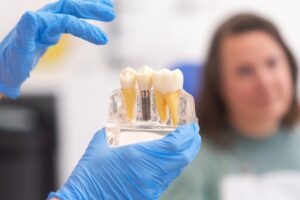
Crowns and bridges are not the only options for restoring missing teeth. Dental implants provide another approach by replacing the missing tooth root before a restoration is attached.
For some patients, dental implant surgery may provide a stable long-term replacement option.
Implant treatment may be particularly useful when preserving the surrounding teeth is important or when a patient wants a fixed replacement that does not rely on neighboring teeth for support.
A dental examination is necessary to determine which option is appropriate.
How to Care for Crowns and Bridges
Crowns and bridges require many of the same daily habits as natural teeth.
To protect your restoration:
- Brush twice a day with fluoride toothpaste.
- Clean carefully around the gumline.
- Floss daily and clean beneath a bridge as recommended.
- Avoid chewing excessively hard objects.
- Attend regular dental examinations and cleanings.
Good oral hygiene is particularly important because the natural teeth and gums surrounding a restoration still require protection from decay and gum disease.
Routine care through family dentistry can help monitor your restoration and surrounding oral structures.
What Happens During a Restoration Consultation?
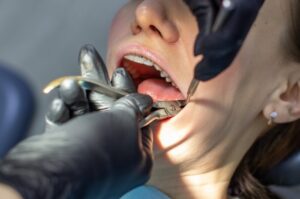
Your dentist will examine the affected tooth or missing-tooth area and evaluate your bite and surrounding teeth. X-rays or other diagnostic images may be recommended when additional information is needed.
Your dentist can then explain the available options, expected benefits, limitations, and maintenance requirements.
The goal is not simply to repair a damaged tooth or fill a gap. The restoration should also function properly and fit comfortably within your overall bite.
Restore Your Smile in Katy, TX
Whether you have a severely damaged tooth or a missing tooth, restorative dentistry can help restore function and appearance.
Sapphire Family Dentistry in Katy, TX offers crowns, bridges, implants, and other restorative solutions based on individual patient needs. Contact Sapphire Family Dentistry to schedule an evaluation and discuss your treatment options.